Secondary Containment for Oil & Gas: Essential Systems and EPA Compliance Guide
Written by

Chem Fox
Publish on 24 Aug, 2026
Why oil and gas spills need to be taken seriously ?
- Environmental hazard: untreated crude oil, diesel, and industrial lubricant spills contaminate soil and groundwater, destroy aquatic and terrestrial ecosystems, and leave persistent ecological damage that requires years of high-cost remediation.
- Economic losses: landmark industry incidents highlight the extreme stakes. The 2010 BP Deepwater Horizon spill incurred over $65 billion in total damages, covering cleanup costs, prolonged operational shutdowns, and legal compensation claims.
- Compliance requirements: EPA and OSHA enforce rigorous spill control mandates, with non-compliance fines starting at $50,000 per violation, paired with mandatory facility audits and temporary operational halts.
Adopting tailored industry-specific spill solutions enables facility managers to mitigate distinct onshore and offshore spill risks and maintain consistent 2026 regulatory alignment.
What is Secondary Containment in Oil & Gas?
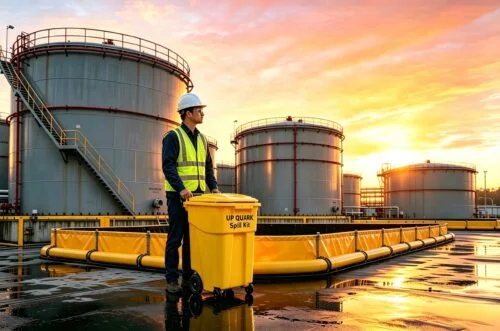
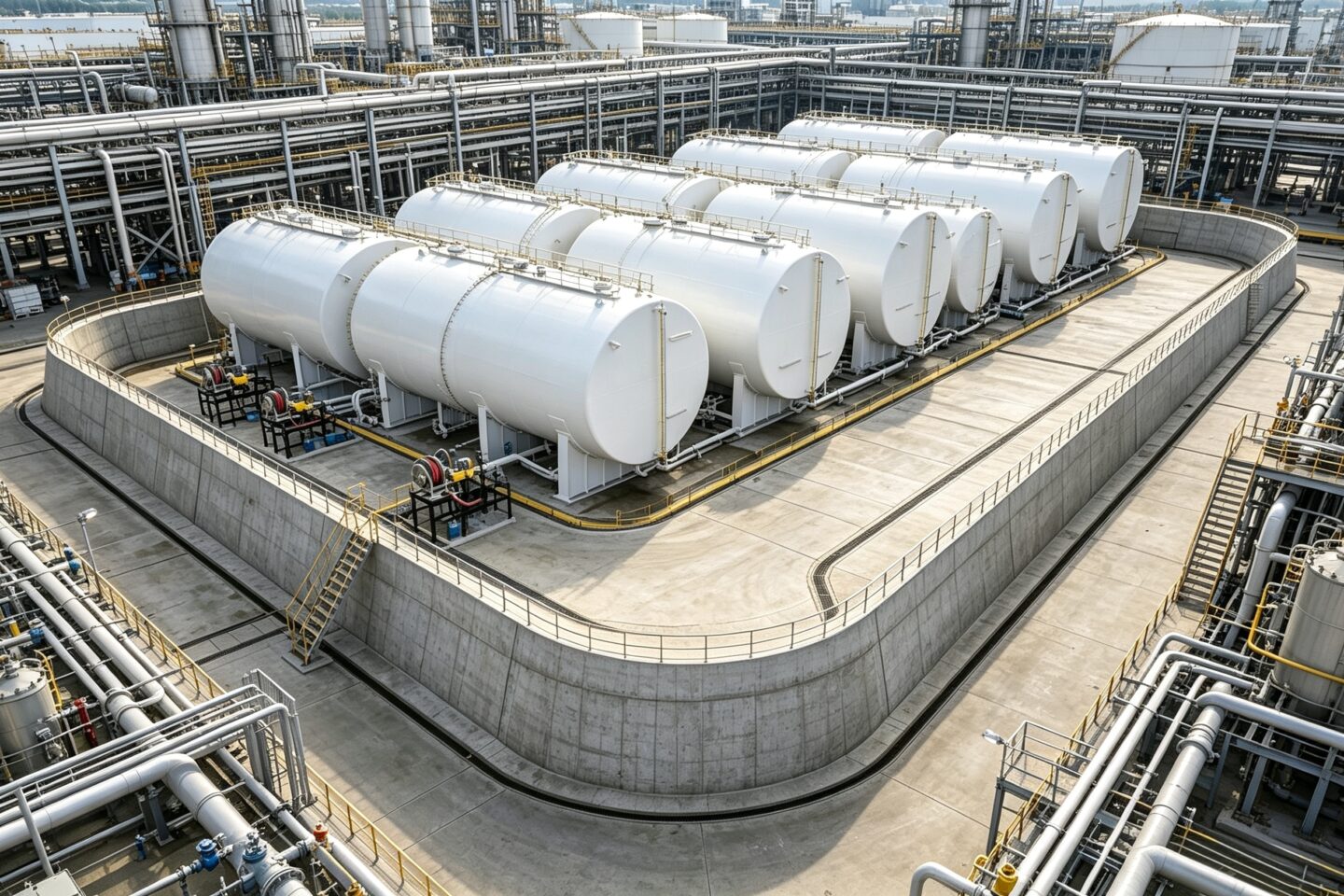
In the oil and gas industry, secondary containment serves as a critical redundant pollution control measure that differs from primary containment. While primary containment refers to direct holding equipment such as storage tanks, pipelines and process vessels, secondary containment acts as an external backup barrier to catch accidental spills. Its target pollutants mainly include crude oil, refined fuels, and various hydrocarbon fluids. This system is widely installed at typical oil and gas sites, including tank farms, production well pads, fuel storage yards and onshore processing facilities.
2025/2026 Industry Statistics & Market Data
Global demand for professional oil and gas spill containment systems continues to surge, driven by stricter 2026 EPA compliance mandates, aging global energy infrastructure, and rising industrial environmental risk awareness. According to Future Market Insights’ Spill Containment Systems Market 2026–2036, the global spill containment market is valued at USD 1.1 billion in 2026 and will grow at a steady 9.3% CAGR, reaching a projected USD 2.7 billion by 2036.
The oil and gas and chemical storage sectors dominate the industry, accounting for 40% of end-use market share due to their high-hazard operational profiles and strict federal regulatory requirements. Spill berms, fixed concrete dikes, and containment pallets lead industry product adoption with a 45% market share, favored for their flexible deployment, cost efficiency, and consistent SPCC compliance across temporary job sites and permanent industrial facilities.
Real-world incident data further underscores the urgency of robust secondary containment. Since 1993, over 30,000 oil and chemical spills have occurred annually across the United States, ranging from undetected minor seepage to large-scale industrial disasters. Aging onshore and offshore equipment continues to elevate daily leakage risks, making proactive secondary containment a critical operational investment rather than an optional upgrade. Supplementary ITOPF spill statistics confirm persistently high hydrocarbon spill volumes in energy-intensive regions, further validating the necessity of industry-specific containment infrastructure.
Source:
Future Market Insights: Spill Containment Systems Market 2026-2036
ITOPF: Oil Tanker Spill Statistics 2025
EPA Regulations and SPCC Compliance
All U.S.-based oil and gas facilities are legally obligated to comply with EPA 40 CFR Part 112, widely known as the SPCC (Spill Prevention, Control, and Countermeasure) Rule. The 2026 EPA “Compliance First” policy reframes federal regulatory oversight, prioritizing proactive spill prevention over reactive penalty issuance. Inspectors now prioritize verified properly sized containment systems, updated maintenance logs, and full on-site spill response readiness during all official audits.
Every facility storing, processing, or transporting bulk hydrocarbons must maintain a current, site-specific SPCC Plan. This formal documentation includes detailed on-site hazard assessments, containment system technical specifications, routine inspection schedules, and standardized emergency spill response protocols. To sustain full compliance, operators must update the plan annually, or immediately after any operational, structural, or equipment changes that alter on-site spill risk levels.
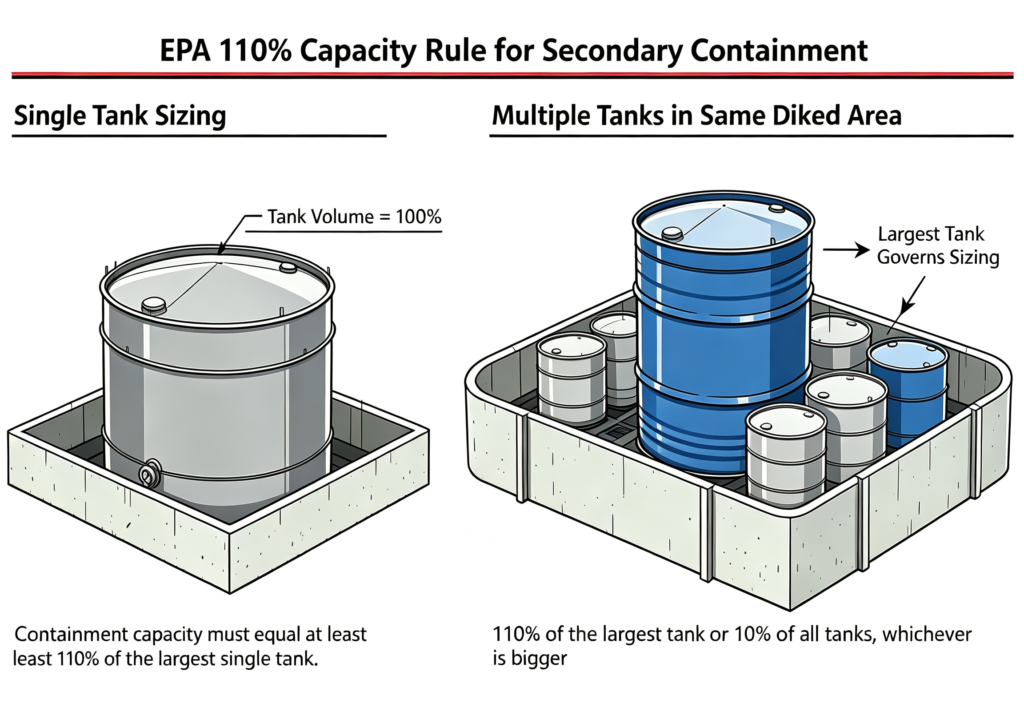
The definitive compliance benchmark for oil and gas sites is the EPA 110% Rule. All secondary containment structures for petroleum storage tanks must hold a minimum of 110% of the volume of the largest on-site primary tank, with a dedicated freeboard reserved for rainfall accumulation. This stringent standard ensures complete spill capture during full tank failures, effectively preventing soil and water contamination—the leading cause of EPA violations for energy facilities nationwide.
Top Secondary Containment Systems for Oil and Gas
Oil and gas operations depend on layered, industry-tailored containment solutions to mitigate high-volume, flammable hydrocarbon spills and sustain full 2026 SPCC compliance. Generic industrial containment tools fail to withstand harsh field conditions and cannot meet federal sizing and material safety standards. Below are the four most widely used secondary containment systems in compliance with EPA requirements:
1. Spill Berms
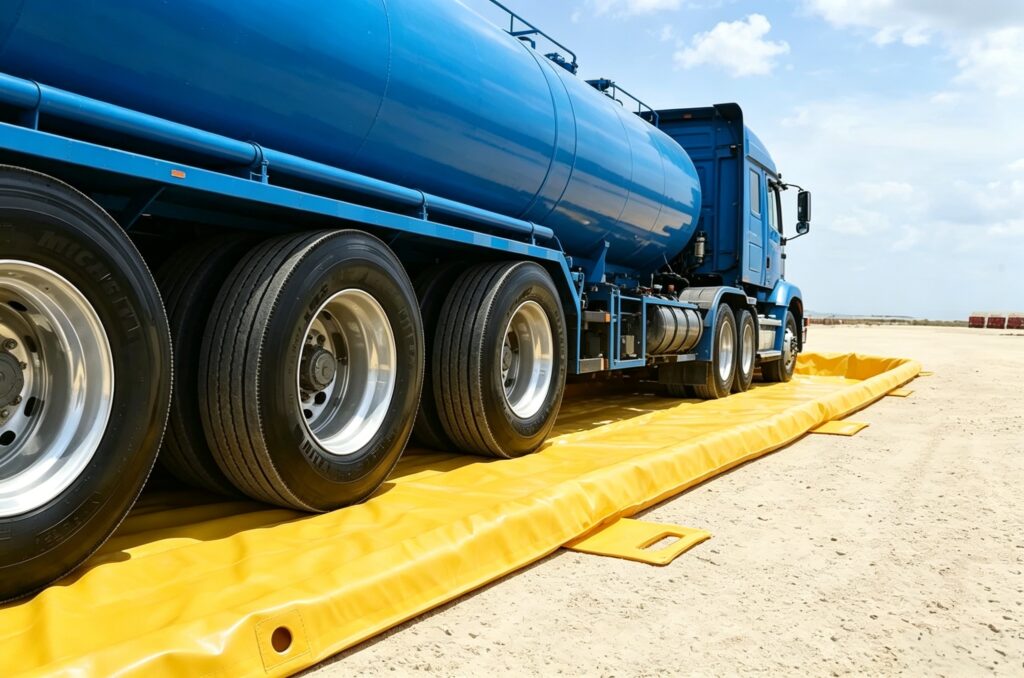
Spill berms are the most flexible and versatile containment solution for dynamic oil and gas worksites. Lightweight, tool-free deployable, and fully portable, they are ideal for temporary drilling zones, remote offshore platforms, and mobile tanker fuel transfer areas. Constructed with UV-stable, hydrocarbon-resistant materials, these berms form full-perimeter leak-proof barriers that block oil spill spread on both land and open water, delivering reliable passive spill protection for short-term projects and seasonal field operations.
2. Spill Containment Pallets
EPA-compliant spill containment pallets serve as the foundational compliance tool for permanent drum and IBC tote storage at oil and gas facilities. Featuring a seamless one-piece impermeable structure, these pallets eliminate secondary leakage risks common with low-quality segmented designs. UPQUARK certified by TÜV and BV, they meet strict EPA 40 CFR 264.175 and SPCC 40 CFR 112.7 regulatory criteria. Heavy-duty, drainable, and steel-reinforced models withstand extreme outdoor temperatures and harsh industrial environments, making them perfect for refineries, storage terminals, and bulk hydrocarbon storage zones.
3. Liner Systems & Geomembranes
Industrial-grade geomembrane liner systems reinforce earthen dikes, temporary containment basins, and fuel transfer zones to prevent hydrocarbon seepage into soil and groundwater—one of the most prevalent and costly long-term compliance violations for aging oil and gas sites. These specialized liners resist UV degradation, extreme weather fluctuations, and prolonged chemical exposure from crude oil and refined fuels. They deliver long-term structural stability and consistent adherence to EPA environmental discharge regulations for both onshore and offshore facilities.
4. Concrete Basins & Dikes
Reinforced concrete basins and permanent dikes are heavy-duty, long-term secondary containment solutions for large-scale tank farms and refineries. Explicitly engineered to satisfy the EPA 110% capacity rule, these rigid structures are fire-resistant, corrosion-proof, and capable of containing complete tank ruptures. With minimal ongoing maintenance requirements, they provide decades of reliable, fail-safe compliance, earning status as the gold standard for fixed, high-volume petroleum storage facilities.
Conclusion
Secondary containment forms the core defensive layer that shields oil and gas facilities from irreversible environmental degradation, multi-million-dollar financial losses, and costly EPA regulatory penalties. Generic spill kits and universal containment equipment are fundamentally incapable of addressing the industry’s unique high-volume, flammable hydrocarbon hazards, creating preventable compliance gaps and recurring incident risks.
Spill control solutions tailored by industry ensure berms, pallets, liners, and dikes are fully rated for petroleum-specific risks, keeping facilities audit-ready, fully compliant with 2026 EPA SPCC standards, and protected from avoidable spill incidents year-round.