How to Calculate Secondary Containment Capacity: The 110% Rule Explained
Written by

Chem Fox
Publish on 31 Mar, 2026
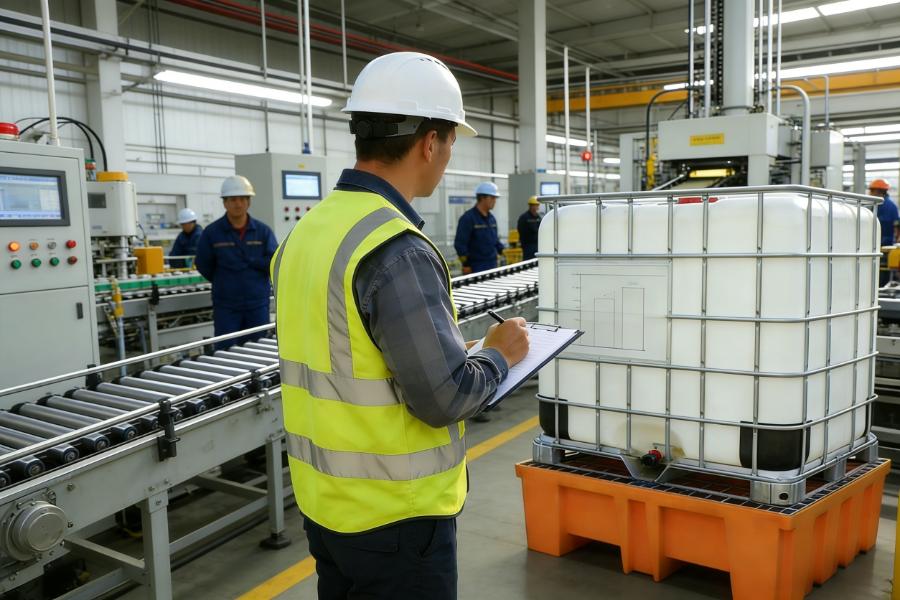
In previous articles, we learned about the basics of secondary containment through "Secondary Containment 101" and have a general idea when and where the spill containment pallet is needed.
For industrial facilities engaged in bulk storage of hazardous liquids, petroleum derivatives, and chemical commodities, secondary containment is a statutorily mandated compliance with the “110% rule”;
And this article targets to:
- Deliver comprehensive technical analysis of the 110% secondary containment capacity standard
- Dispel pervasive industry misconceptions
- Delineate a rigorous step-by-step computational framework
- Prescribe evidence-based guidance for maintaining full adherence to EPA and SPCC regulatory requirements
Demystifying the 110% Rule: What Does the EPA Actually Say?
EPA SPCC Statutory Framework (40 CFR §112.8(c)(2))
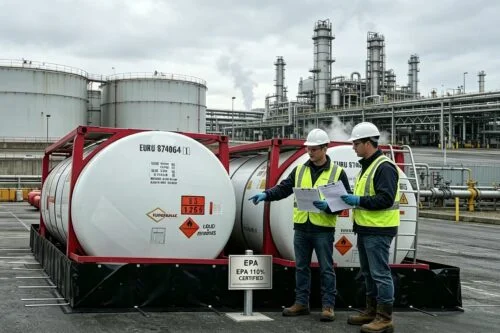
The EPA’s SPCC regulation explicitly requires containment structures to retain the maximum potential volumetric discharge from the largest single container within a designated storage footprint, supplemented by additional capacity to accommodate hydrological inputs.
The "110% rule": Myth vs. Reality
EPA does not codify a mandatory 110% capacity threshold within federal SPCC statutes. Instead, the 110% standard constitutes a universally adopted industry best practice and pragmatic compliance–typically quantified as a 25-year, 24-hour precipitation event per regional engineering standards.
The 10% volumetric buffer is engineered to account for three key operational and environmental variables:
- Incidental overflows and splashes during liquid transfer, dispensing, and filling operations
- Accumulation of stormwater, snowmelt, and atmospheric precipitation within the containment footprint
- Minor computational variances and field measurement tolerances inherent to practical storage configuration assessments
Step-by-Step Guide: How to Calculate Secondary Containment Capacity
This section illustrates how to calculate single-container, multi-container, and displacement-adjusted scenarios in consideration of regulatory compliance and field-ready accuracy.
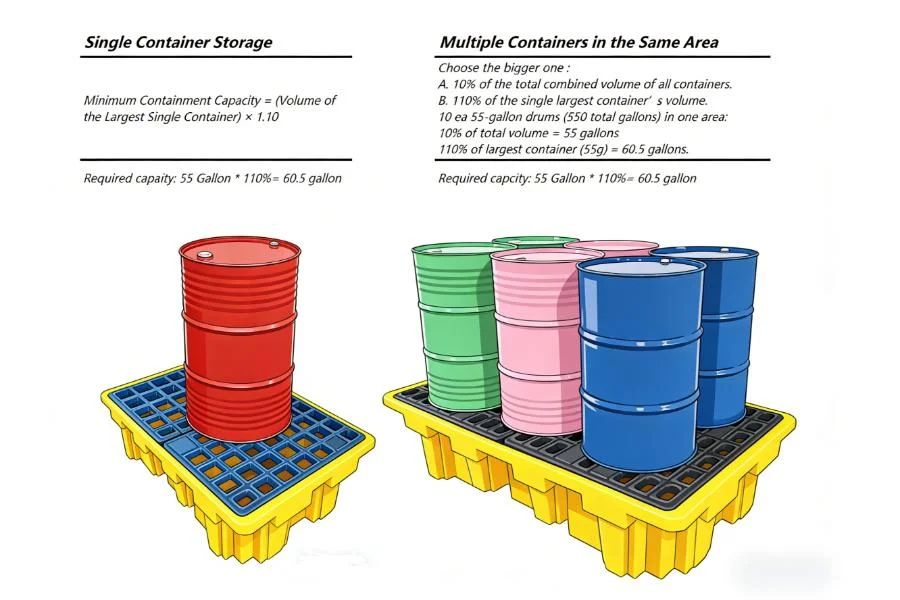
Formula for Single Container Storage
For individual storage vessels—including tanks, drums, and intermediate bulk containers (IBCs)—the minimum required containment capacity is calculated using the following formula:
- Minimum Containment Capacity = (Volume of the Single Container) × 1.10
- Illustrative Technical Example: A 50-gallon petroleum storage tank requires a secondary containment system with a minimum capacity of 60.5 gallons (55 × 110%).
Formula for Multiple Containers in the Same Area
For multiple containers in the same area under EPA regulations (SPCC and 40 CFR 264.175), secondary containment must hold:
- The greater of 110% of the largest container’s volume or
- 10% of the total volume of all containers.
- Use the higher of these two values as the required capacity.
Illustrative Technical Example: Storing ten 55-gallon drums (550 total gallons) in one area:
| Calculation Method: | 10% of total volume | 110% of largest container |
| Mathematics Result: | 55 gallon*10ea*10%=55 Gallon | 55 gallon* 110%=60.5 Gallon |
| Requirement: | The containment system must hold at least 60.5 gallons. | |
Freeboard Requirement: If the containment is outdoors, the system must hold the required volume plus additional capacity for a 24-hour, 25-year storm event (often managed by adding a 10% freeboard allowance to the 110% figure).
Considering the Displacement Volume
Critical engineering consideration must be given to structural displacement volume, defined as the volumetric space occupied by container bases, support structures, fixed piping, and permanent fixtures within the containment perimeter. This factor reduces the system’s effective holding capacity, requiring a compensatory adjustment to the baseline calculation:
- Final Design Containment Capacity = (Largest Container Volume × 1.10) + Total Displacement Volume
Common sources of structural displacement include tank support legs, reinforced concrete piers, drum racking systems, and fixed piping assemblies located within the containment boundary.
Why Accurate Sizing is Important
Inadequate containment capacity caused industrial incidents include:
- 1988 Ashland Petroleum Spill: Catastrophic tank failure compounded by insufficient containment capacity caused widespread aquatic ecosystem contamination and protracted, high-cost environmental remediation.
- 2025 Houston Sulfuric Acid Spill: Miscalibrated containment dimensions triggered a toxic chemical discharge, disrupting municipal operations, harming local communities, and resulting in severe regulatory enforcement actions. Review technical compliance lessons from this incident.
The primary adverse outcomes of inaccurate containment capacity calculations include:
- Civil penalties and enforceable compliance orders issued by the EPA and state regulatory agencies
- Exorbitant emergency spill response, remediation, and site restoration expenditures
- Permanent soil and groundwater contamination, creating long-term environmental liability
- Workplace safety hazards and mandatory operational shutdowns per regulatory directives
- Irreparable reputational damage and erosion of stakeholder, client, and community trust
Choosing the Right Containment Equipment for Your Calculated Volume
Once containment capacity requirements are finalized, facility engineering and EHS teams should select containment systems that meet SPCC regulatory standards and are engineered for the facility’s unique storage profile, operational conditions, and hazardous material characteristics.
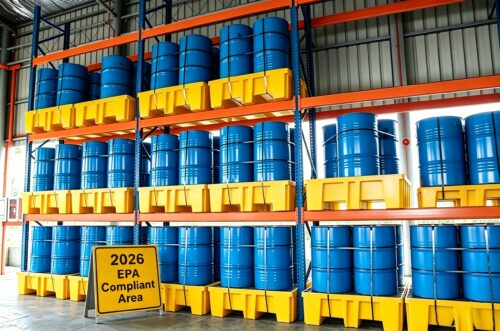
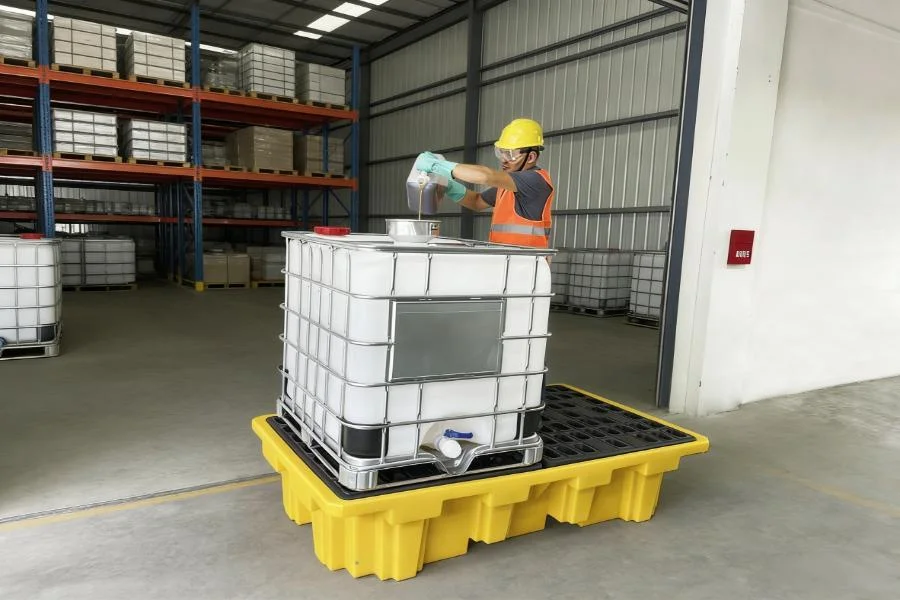
Drum and IBC Spill Containment Pallets
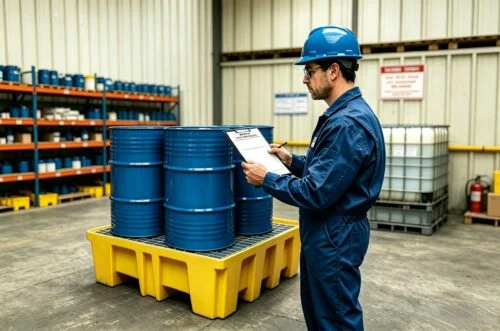
Designed for stationary drum and IBC storage applications, these industrial-grade units are SPCC-compliant drum spill pallets. Featured compact, corrosion-resistant construction and integrated sump reservoirs built to meet 110% capacity requirements for low-to-moderate volume bulk storage. All systems are SPCC-compliant and optimized for seamless industrial workspace integration.
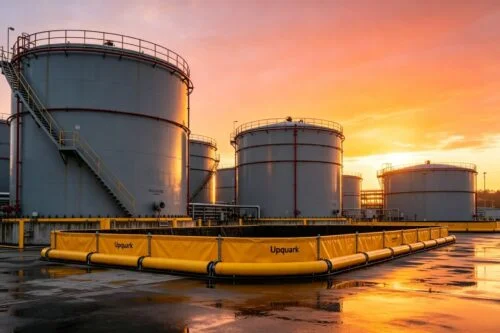
Flexible Spill Containment Berms
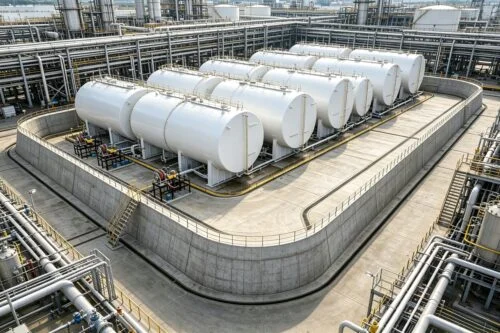
Ideal for temporary storage, bulk tank farms, and mobile equipment applications, flexible containment berms enable rapid deployment, customizable dimensions, and scalable volumetric capacity to meet large-scale 110% compliance mandates. These systems perform reliably in indoor and outdoor settings and adapt to uneven subgrade conditions.
Frequently Asked Questions about Containment Capacity
- Q: Do I need secondary containment for 55-gallon drums?
A: Yes. Federal SPCC requirements and most state-level environmental regulations mandate secondary containment for 55-gallon hazardous material drums, regardless of storage volume. Certified spill pallets are the industry-standard compliance solution. - Q: What should I do if my containment area is indoors?
A: Indoor containment structures must still meet the 110% capacity threshold; however, stormwater freeboard calculations are not applicable. Compliance with local fire codes, ventilation standards, and occupational safety regulations is also required. - Q: How do I calculate "sufficient freeboard" for my specific geographic area?
A: Use the NOAA Precipitation Frequency Data Server to retrieve 25-year, 24-hour storm precipitation data for the facility’s geographic location. This volumetric value must be added to the baseline 110% capacity calculation for all outdoor containment systems.
Regulatory and Technical References