2026 EPA Secondary Containment Requirements
Written by

Chem Fox
Publish on 13 Jul, 2026

What’s 2026 EPA Secondary Containment and where it applies ?
1. Core Purpose of the SPCC Rule
Administered by EPA under 40 CFR Part 112, the SPCC Rule is a federal compliance regulation that prevents unauthorized petroleum spills, discharges and leakages into U.S. navigable waters and adjoining shorelines. It governs on-site petroleum storage and handling activities to mitigate contamination hazards, protect aquatic resources, and eliminate relevant operational and safety liabilities for regulated facilities.
2. Applicable Threshold Standards of the SPCC Rule
Under 40 CFR Part 112, non-transportation petroleum facilities trigger mandatory SPCC compliance when possessing an aggregate aboveground storage (AGS) exceeding 1,320 US gallons or aggregate underground storage (UGS) exceeding 42,000 US gallons, calculated by total on-site storage volume. Eligible facilities shall develop, certify and update site-specific SPCC Plans, and sustain routine inspections and spill emergency response systems for regulatory compliance.
What Are the EPA Secondary Containment Requirements?
1. Core Purpose of the SPCC Rule
The SPCC rule’s core objective is to prevent avoidable industrial liquid spills. It enforces reliable backup containment to reduce environmental contamination, protect public water resources and standardize spill prevention protocols nationwide. The rules cover both permanent storage zones and temporary liquid transfer areas at regulated facilities.
2. Regulatory Thresholds for Compliance
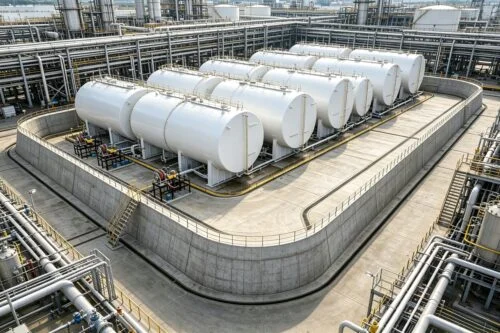
Facilities need formal SPCC compliance programs if their aboveground bulk liquid storage can cause water pollution. This includes sites operating 55-gallon drums, IBC totes, stationary tanks and tanker transfer stations. All liquid handling and transfer zones fall under federal secondary containment requirements.
3. Key Regulation: 40 CFR §112.7(c)
40 CFR §112.7(c) is the core federal standard for secondary containment design and capacity. All compliant systems must meet these key rules:
- Full Failure Coverage: Containment systems must hold the entire volume of the largest single container in the storage zone, plus adequate freeboard to accommodate rainfall and prevent overflow.
- Leak-Proof Construction: All containment walls and floors must be impermeable to stored liquids, ensuring no spilled material escapes before cleanup operations begin.
- Practical Design Standards: Systems only need to address typical container failure modes and maximum foreseeable spill volumes, avoiding over-engineering while maintaining full protection.
- Flexible Layouts: EPA does not require separate containment for every individual container. Facilities may use centralized common collection zones for multiple drums and tanks to streamline compliance.
EPA does not require formal capacity calculation documents in SPCC filings. However, inspectors strongly recommend keeping detailed sizing records onsite to verify compliance during audits.
2026 SPCC Statistics and Enforcement News
Updated Federal Penalty Adjustments (2025–2026)
The EPA has raised maximum civil penalties for 2026 SPCC violations. Common violations include insufficient secondary containment, missing compliance records and uninspected containment equipment. Repeat and intentional violations trigger tiered fines based on facility scale, spill risk and violation duration.
Industry Incident Precedent: 2025 Smitty's Supply Facility Explosion
The 2025 Smitty's Supply facility incident illustrates the dangers of inadequate secondary containment. A chemical spill and subsequent explosion occurred due to insufficient spill capture infrastructure. The incident caused severe environmental harm, costly penalties and extended operational shutdowns. It also prompted the EPA to launch targeted nationwide inspections of chemical and bulk liquid storage facilities in 2026.
EPA’s 2026 “Compliance First” Mandate
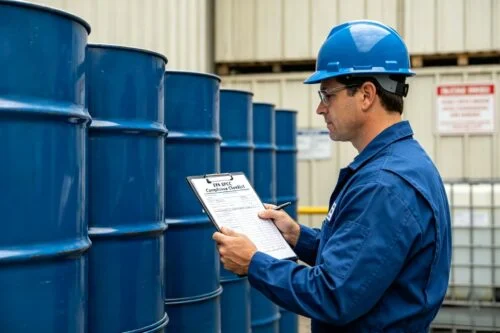
Built on late-2025 policy updates, the “EPA Compliance First” framework prioritizes proactive prevention over penalty enforcement. Inspectors focus on three key areas: properly sized secondary containment, routine equipment maintenance logs and verified spill response readiness. Facilities with pre-approved compliant equipment qualify for faster, streamlined inspections.
How to Choose Compliant Secondary Containment Equipment
Using EPA-verified, SPCC-compliant equipment is the most effective way to eliminate compliance gaps. All UPQUARK solutions fully comply with EPA 40 CFR 264.175, SPCC 40 CFR 112.7 and UK PPG26 international secondary containment standards.
1. For 55-Gallon Drums
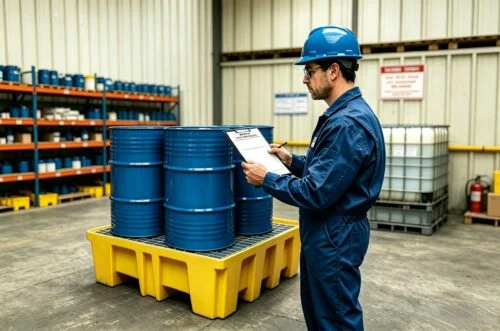
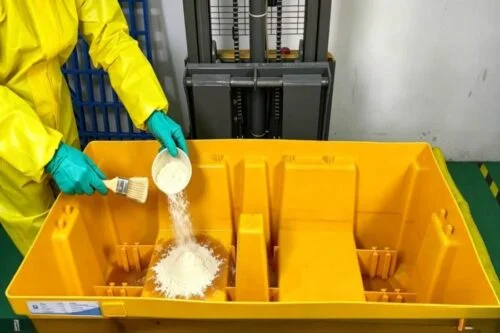
Drum spill pallets are engineered exclusively for standard 55-gallon drums. Their seamless sump structure eliminates secondary leakage risks. Multiple models cover single-unit to large-scale warehouse storage scenarios:
- Single Drum Spill Pallet: Compact solution for single 55-gallon drum storage, it is designed for space-limited work areas. Ideal for small-scale storage stations and individual chemical drum placement.
- 2-Drum and 4-Drum Spill Pallet Series: Most common spill containment pallet model and options for drain plug. Normally in yellow or orange color for high-visibility, perfect for dedicated hazmat storage zones.
- 10-Drum High-Capacity Pallet: Designed for large-scale warehouse storage, equipped with a 1100+L ultra-large sump and 3600+kg extreme load capacity.
- Steel Fire-Rated Pallets: Specialized for flammable liquid storage, meeting strict fire safety and SPCC compliance requirements for flammable liquid facilities.
- Mobile Steel Pallet: Combines 400+kg heavy-duty load capacity and fire-resistant steel material, supporting flexible mobile drum containment for temporary liquid transfer and mobile work zones.
Pls feel free to reach UPQUARK to explore compliant drum spill pallets

2. For IBC Totes & Tankers
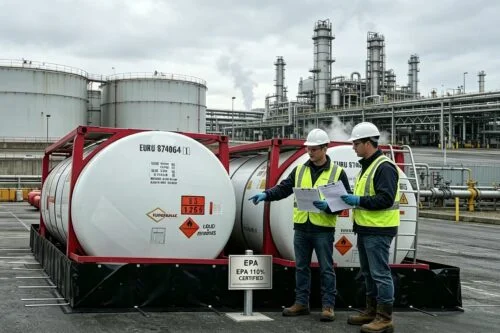
SPill containment berms deliver flexible, high-volume secondary containment for IBC totes, mobile tankers and bulk liquid transfer zones. Reusable and rapidly deployable, these berms support both temporary emergency use and long-term fixed-site deployment while maintaining full EPA and SPCC compliance.
- IBC & ISO Tank Containment Berms: Custom-built for standard IBC totes and large ISO tanks, featuring reinforced L-bracket support and foldable wall designs. The foldable structure enables easy equipment loading and quick setup, while the chemical-resistant liner prevents liquid penetration, fully meeting EPA spill capture requirements for large container storage.
- Foam Wall Drive-Over Berms: Low-profile, rapid-deployment berms with flexible foam walls that allow direct vehicle and equipment drive-in access. Suitable for frequent entry-exit operation zones, delivering reliable leak prevention without sacrificing operational convenience.
- Quick Snap & L-Bracket Heavy-Duty Berms: High-capacity professional models with maximum sump capacities. Support personalized size customization, ideal for large equipment parking, tanker transfer stations, and wide-area facility containment scenarios.
- Outdoor Oil Filter Mat: Specialized outdoor containment accessory with integrated filtration and high-capacity liner design, durable enough for long-term outdoor exposure, solving scattered spill and residual liquid filtration problems for outdoor storage zones.
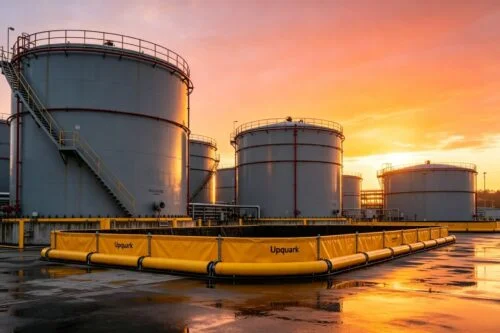
UPQUARK spill containment berms deliver flexible, high-volume secondary containment for IBC totes, mobile tankers and bulk liquid transfer zones.

3. For Facility Floors & Transfer Zones
Custom permanent floor containment systems suit fixed liquid handling and transfer zones. These compliant setups feature impermeable surfaces, graded drainage and centralized collection basins that meet EPA freeboard and spill retention rules. Professionally designed layouts avoid flood-prone areas and prevent spilled liquid migration.
Frequently Asked Questions
1. Do I need separate containment for every single container?
No. 40 CFR §112.7(c) permits shared containment zones for multiple containers. Facilities can group drums and tanks in centralized collection areas, as long as the total capacity meets spill volume and freeboard requirements for the largest container onsite.
2. Are 55-gallon drums regulated under SPCC?
Yes. Standard 55-gallon oil and chemical drums fall under official SPCC regulations. Any facility storing bulk liquids in 55-gallon drums must deploy compliant secondary containment to pass EPA inspections and avoid penalties.
3. What materials are acceptable for EPA-compliant containment?
Only two industrial-grade material types qualify for 2026 EPA and SPCC secondary containment standards, each suited for distinct working conditions:
- Seamless HDPE/LLDPE Plastic: Adopts industrial ESCR180-grade chemical-resistant plastic, 20 times more resistant to chemical stress cracking than ordinary HDPE materials. Features integral seamless molding to eliminate splicing leakage risks, with UV-stabilized and weather-resistant performance. Perfect for long-term storage of corrosive chemicals, oil liquids, and outdoor deployed containment equipment.
- Reinforced Double-Layer Steel: 3mm thick double-layer fireproof steel structure with excellent fire resistance and extreme load-bearing capacity. Strictly complies with industrial fire safety protocols, specially applicable to flammable and explosive liquid storage scenarios and high-traffic heavy-load industrial zones.
- All approved materials must be fully impermeable to stored liquids and free of structural defects that cause leakage or spill escape.